
Hiiraan Online Editorial
Wednesday, December 24, 2014
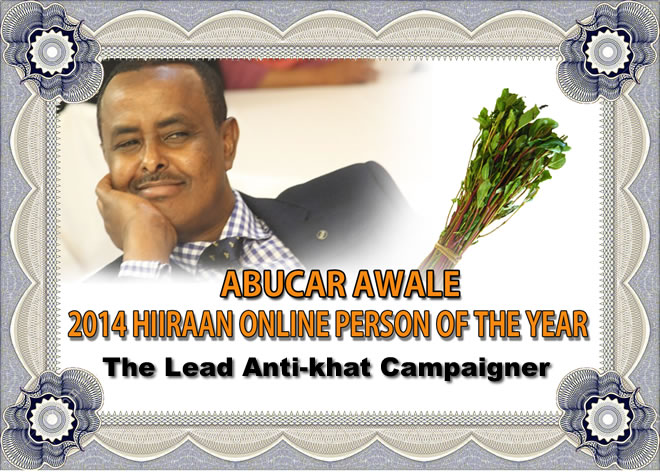
This years HOL Person of the year is Abukar Awale for his dedication to the Stop Khat in the UK campaign. His journey is one of great struggle and incredible humility. In July of 1997, when Abukar first arrived in the UK, he had high hopes of England and felt lucky to have escaped the civil war in Somalia. He vividly remembers calling his family to tell them he made it. Awale applied for asylum and, like many others left waiting for their asylum decision from the British Home Office, was unable to work.
At this time of great insecurity he sought advice from people in the Merfish who were chewing khat. The young men he met there persuaded him to start chewing to relieve his pain and to forget about his worries. However, what started as light relief became a cycle of addiction. Awale began to feel the effects of chewing daily on his personal life. He always woke up late in the afternoon, constantly felt moody and aggressive and was spending his meagre state financial support on his addiction. He told HOL in an exclusive interview, “Your face shows all the problems and when you wake up you must go and chew again.”
Like many other Khat addicts, Abukar very quickly lost his self-esteem and confidence, and as a result of his addiction lost all contact with his family. Abukar described this as the lowest point in his life and he subsequently became depressed and paranoid. Witnessing the success of fellow Somalis attending University and working made him feel extremely ashamed and extremely embarrassed.
Things were not looking promising for Abukar at this point in his life and in 2004, he was a victim of a horrendous assault where he was stabbed four times by heavy Khat addict. Despite suffering this attack, Abukar tells HOL how thankful he was to the man who nearly killed him.
“It took a knife to knock some sense into my head,” Awale said. Doctors told him he was lucky to survive. Covered in blood and chewing Khat at the time, Abukar was thinking what kind of life he was leading and considered where his life was heading. He tells anyone who will listen to him today how, although this was the lowest point in his life, it was also the turning point he so desperately needed. Covered in blood and high on khat, Abukar prayed to God to show him the right path from that night onwards. According to Abukar, nothing focuses the mind more than the prospect of death at a time where one has achieved very little in their time on earth.
Luckily Abukar’s Prayers were answered and he strived harder to make changes in his life. With the help of a lawyer, Abukar put pressure on the Home Office and was finally granted status to live and work legally in the UK. After this, he quickly secured employment and started to feel confident as he was earning money as a respectful member of society. He was able to fulfil his wish to tell his mother back home in Somalia that he had been successful. Although Abukar stopped chewing khat and moving forward in the right direction, he felt morally obliged to support the others who were not so lucky. From this, his campaign Stop Khat UK was born.
In 2004 he studied Community Development and Leadership at London Metropolitan University. The whole aim for Abukar was to learn the essential skills needed to work towards becoming an effective leader and campaign organiser to bring about the ban of Khat in the UK. In 2005, whilst working in a primary school, Abukar would see a lollipop man every morning with a STOP sign on it and he had a strong vision for his sign to read Stop Khat coming to UK on his imaginary lollipop.
Abukar’s campaign began with the setting up of workshops titled ‘Before you chew’ across northwest London, which aimed to raise awareness of the negative impacts of Khat. Abukar received positive feedback as his sessions were benefiting the community. The campaign received coverage from local newspapers and BBC London which helped to raise the profile of the work he was doing. Abukar began to challenge the legality of Khat in the UK and met with his local MP and set up a petition to stop it. This petition, which he collected through signatures, had reached 72,000 by 2009. The Conservative party invited him to parliament and Abukar met with the current Justice Secretary Chris Grayling to discuss the issue of banning Khat. After this positive meeting with a very senior and influential government Minister, Abukar was one step closer to achieving his goal. He always argued that Khat was a massive barrier to integration and with his knowledge of Khat he was able to highlight the negative effects Khat usage being legal was having on the community. Through his direct public campaigns, Abukar became a popular figure on Somali television and his reputation within the Somalia communities across the world grew.
Despite the popularity of his anti-khat message, there were still many hurdles to climb before banning it ever came about. The British Advisory Council on the Misuse of Drugs (ACMD) published a report showing no evidence of Khats social harm and were against the ban. Their reports conclusion implied that negative effects of Khat were not spreading to wider society and that it was a drug, if used responsibly, had limited or no long term health and social impact on users. Abukar challenged this and accused the ACMD of discrimination and ignoring the Somali community’s needs. Many in his community across the world, and especially women in the UK, agreed and campaigned alongside him to lobby the British Home Secretary Teressa May MP to go ahead with the ban on the grounds of its social impact on their community. Abukar’s dream was realised on the 24th June 2014 when Khat officially became a class C drug and its use and sale was banned by law.
After the khat ban, Abukar took the Somali community, mainly Somali mothers, to meet Teresa May MP and celebrate. Abukar remembers a moving moment when a young Somali girl who had he lost her father to Khat spoke to Teresa May and said “Thank you very much, I hope I will spend time with my dad.”
Abukar’s future ambition is to return to Somalia to continue his campaign. He endeavours for his Qaadiid Foundation' to put pressure on policy makers to develop health regulations around Khat.
"The amount of money Somalis spend on Khat is more than the Somali Government spends annually. People have already been wounded by civil war, we need to stand up, it’s not acceptable." In Somalia Khat is cheap to buy and young children as old as eight are users. Abukar is determined to fight back against the importing of Khat by Kenya and Ethiopia. Abukar’s ‘Qaadiid Foundation’ is working towards raising awareness and is committed to the long term fight to ban Khat in Somalia. He knows it is a long road ahead and it comes with many risks. Abukar has received death threats as a result of his work but still persisted and he intends to do the same in his fight within Somalia too. Abukar strongly believes he said God has purpose for each person and his inspirational message to his community is that we must unite and stand up in as a collective to ban Khat.
For his mobilisation of his community in the UK and for successfully leading and being the face of the successful Ban Khat campaign in the UK over the last few years which finally realised its goals in June 2014, Abukar Awale is 2014 HOL Person of the year.
 |
 |
 |
 |
 |
 |
 |
 |
 |
 |