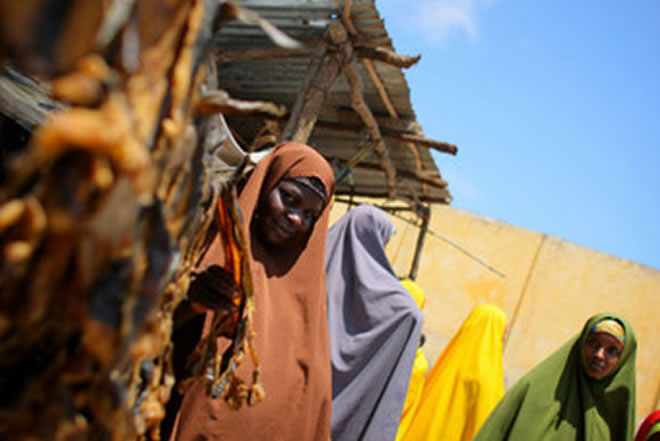
A Somali woman sells dried fish from a kiosk in a market area in the centre of the southern Somali port city of Kismayo in October 2012. Women are now learning skills such as net making so they can work in the male-dominated fishing industry

Wednesday, December 24, 2014
The aim of the 45-day programme, which kicked off December 10th in Mogadishu with funding from the European Union, is to teach women skills they can use to get jobs in the country's fishing industry, said HSFA chairperson Hassan Mohamud Roble.
"Since 100% of the people who currently fish are men, we thought women should be part of those who take advantage of marine resource production," he told Sabahi. "We have now started a trial training for 20 women who have been selected from various regions of the country."
In addition to enabling women to pursue careers in the fishing industry, this type of training could have the added effect of reducing the number of young people who engage in acts of piracy through the positive influence of their female family members, Roble told Sabahi.
Women welcome new programme
There is a great need for this type of training, said course participant Madina Hassan Gaal, a 25-year-old divorced mother of two.
Gaal, who lives in Mogadishu's Abdiaziz district, said she used to feed her two children using money she received from her relatives since their father could not find work.
"By God, I am very happy that I am part of this training," she told Sabahi. "I was a stay-at-home mother. Since I will now become a person with job skills, I hope there will be great changes in my life and that I will be able to manage the expenses of my family."
The training will be an encouragement for many women to join the fishing trade, said Salado Omar Ibrahim, a 27-year-old mother of five who lives in Karan district.
"I hope to see many Somali women take part in the production of our marine resources if we regularly receive such trainings," she told Sabahi. "If the person learns a job skill, I believe that person will not need anyone's help. God has blessed our country with many resources that require learning the knowledge to extract them."
Ibrahim called on international agencies and the Somali government to rebuild and support the infrastructure for producing canned fish for domestic consumption and export, which would result in more job creation for both men and women.
Waberi district resident Maryan Dahir, 37, is not a part of the initial cohort, but she told Sabahi she would welcome the opportunity to participate in fishing sector training.
"Even though I do not know much about the training and only heard about it on the media, I would have really liked it if I could receive it as well and if the number of women receiving the training in fishing is increased," said Dahir, a mother of five. "This is a resource that God has blessed our sea with."
Women played an important role in generating income for their families in the years after the collapse of Somalia's central government, even though they did not have vocational training, she said.
"It is a certainty that if training is increased, women will play a visible role in fishing," she said.
Dahir called on the women in the training programme to help teach other women who did not receive the same opportunity the skills they have learned after the training programme ends.