
Monday, December 12, 2016
by: Erika Solomon
Loss for Assad’s forces will raise questions about limitations of air strikes
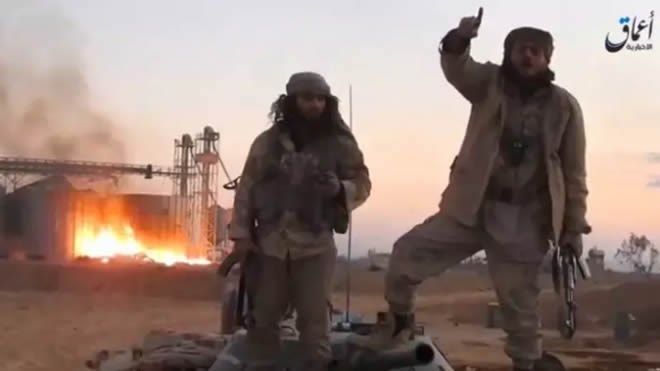
A still image taken from a video released by Isis-affiliated Amaq news agency, said to be in Palmyra © Reuters
Isis fighters have recaptured the ancient Syrian city of Palmyra, despite coming under heavy bombardment by Russian air strikes as they fought to retake the Unesco World Heritage site.
The militants’ success in seizing Palmyra after being forced out of the city in March underlines the limits air power has against the group and the challenges faced by President Bashar al-Assad and his allies in fighting a multi-sided civil war.
On Monday, after four days of fighting, Isis looked firmly in control of the eastern desert city famous for its Roman ruins. Amaq, a news site linked to the jihadi group, said Isis had managed to overcome Assad forces by recapturing a historic citadel overlooking Palmyra and forcing ground troops to retreat from their vantage point under fire.
Mr Assad has been in the ascendant since Russia intervened on his behalf last year. His forces are close to winning back Syria’s strategic northern city of Aleppo with the help of Shia foreign fighters from across the region.
According to anti-Assad activists from the city, which is part of Syria’s large Homs province, foreign fighters and Russian forces had been deployed elsewhere in recent weeks, although their accounts are impossible to verify.
Talal Barazi, Homs governor, said the jihadis had gained reinforcements from Raqqa, the de facto Isis capital in northern Syria, as well as the nearby eastern province of Deir Ezzor,
“The army is using all means to prevent the terrorists from staying in Palmyra,” Mr Barazi was quoted as saying in state media.
Syria’s conflict started off as a protest movement against four decades of Assad family rule, but quickly descended into a complex civil war. Beyond rebels committed to ousting Mr Assad, there are Kurdish forces who have carved out an enclave and seek a decentralised Syria, as well as jihadi groups such as Isis, which hold territory across the country and neighbouring Iraq.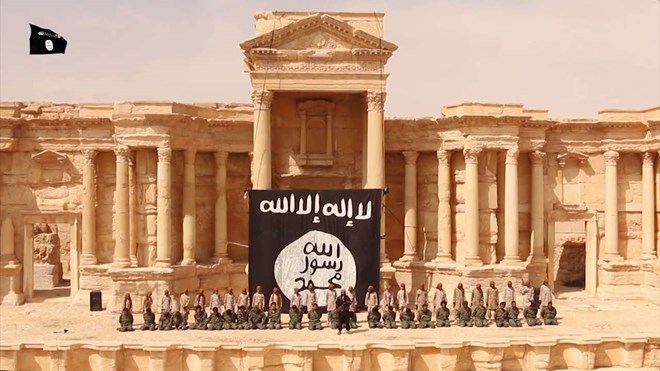
All these sides have fought each other throughout the conflict. Some rebels suggest Mr Assad’s focus on their Aleppo stronghold has overstretched his forces and left them vulnerable to Isis in places such as Palmyra.
Syria and neighbouring Iraq are also having influencing each other’s wars. According to the Syrian Observatory for Human Rights, a UK-based monitoring group with a network of activists across Syria, hundreds of Isis fighters have left Iraq’s second city, Mosul, where a US-led international coalition allied with Iraqi forces is close to pushing Isis out of its last major Iraqi stronghold. The group said 500 fighters reached Syria this week and were sent to different front lines, the bulk to Palmyra.
Video released by Isis showed abandoned tanks and other vehicles and empty streets, with buildings still emblazoned with paintings of the Syrian flag and Mr Assad.
Isis previously captured Palmyra in 2015 and held it for almost a year before it was wrested back by the army supported by Russia and Shia foreign fighters, particularly the Lebanese force Hizbollah.
Last time Isis controlled the city it blew up several ruins, including historic treasures such as the temples of Bel and Baalshamin. The group also staged public executions in the ancient Roman amphitheatre.
The latest Isis attack on Palmyra came after Mr Assad’s forces had a week of rapid gains in Aleppo, where opposition forces have lost more than 90 per cent of their last major urban stronghold. On Sunday night, as Assad forces lost Palmyra, they captured the large rebel-held district of Sheikh Saeed in the city.
Amid the latest fighting, jihadi forces also attacked two gasfields, al-Mahr and Jazal, which are important for Syria’s electricity generation. It is not clear who is now in control of those fields, but residents in Damascus say they have been suffering increased electricity shortages since the Palmyra attack.