
Thursday, December 10, 2015
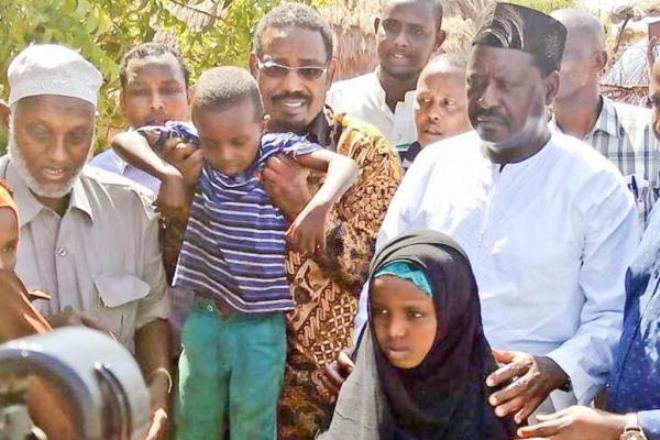
Condolence visit: Cord leader Raila Odinga and National Assembly former Deputy Speaker Farah Maalim with the late Isnina Sheikh?s family in Mandera on Wednesday Photo/Patrick Vidija
advertisements
INTERIOR Cabinet Secretary Joseph Nkaissery says the woman whose body was found buried in a shallow grave in Mandera's Lathe village may have been killed by her al Shabaab accomplices.Nkaissery, who yesterday denied that there were any mass graves, said Isnina Musa Sheikh was an al Shabaab cook in the militants’ Bulla Hawa camp when she fled to Mandera.
She opened a tea kiosk in Mandera town. Her body was discovered in a shallow grave on Sunday.
“She is alleged to have been a cook for Al Shabaab in Bulla Hawa, where they were routed by Amisom and the Somali National Army before she fled into Kenya and started selling tea in a kiosk in Mandera. We believe she was an al Shabaab sympathizer. We don't know [who killed her], maybe al Shabaab,” Nkaissery said.
Saying there were no mass graves found in Mandera or any other part of the country, he added that the security agencies were accompanied by local political leaders, the public and other interested parties when they visited and secured the site before obtaining a court order to exhume the body.
Fifteen other suspect sites were excavated but no other bodies were found.
The CS, who denied the involvement of Kenyan security agencies in alleged extrajudicial killings, demanded an apology from Mandera Senator Billow Kerrow within 24 hours or stern action will be taken against him.
Minutes later, the Senator made the apology, saying: “Sorry, we have since established there are no mass graves in Mandera; only one body has been retrieved.”
Nkaissery said that there has been a tendency to blame the security agencies so that any person killed is presumed to have been murdered by police.
He said that Mandera has continuously experienced fierce inter-clan clashes and conflicts in which the number of people killed is unknown, but it has been much higher than reported.
“In the inter-clan clashes, the locals prefer traditional conflict resolution methods such as levying blood money in terms of cash or animals. We are aware that some leaders have been fined for their involvement in these inter-clan clashes.”