
Saturday April 11, 2020
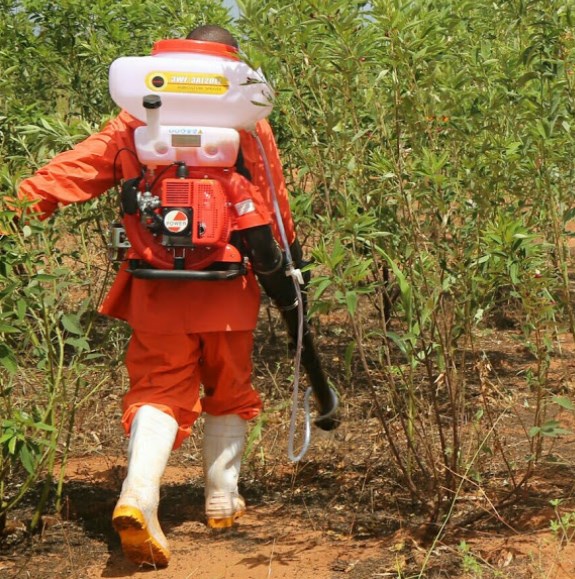
The Covid-19 pandemic is hindering the supply of motorised sprayers and pesticides.
Cyril Ferrand, FAO's Resilience Team Leader for East Africa, has said the biggest challenge at the moment is the supply of pesticides and the delays due to the significant decline in global air freight.
"Our absolute priority is to prevent a breakdown in pesticide stocks in each country. That would be dramatic for rural populations whose livelihoods and food security depend on the success of our control campaign," he said in a statement released on Friday.
Agriculture principal secretary Hamadi Boga said on Wednesday that 600 men from the National Youth Service have been trained and are in the field for control operations.
"The Covid-19 pandemic lockdown has not affected their work because they are moving with security. The services they are offering are some of the essential and crucial and still operational during the pandemic," he said.
FAO is intensifying remote data collection and the network of partners, civil society, extension workers and grassroots organisations to provide information from remote locations, especially in Kenya, Ethiopia, Somalia and South Sudan. Ferrand said this is crucial given that the Covid-19 crisis restricts the movement of personnel in the field.
“FAO is encouraging all countries to use eLocust3, a rugged handheld tablet and app, which records and transmits data in real-time via satellite to national locust centres and to the Desert Locust Information Service,” he said.
According to FAO locust watch update, the desert locust upsurge continues to remain alarming in Kenya, Ethiopia and Somalia. The UN agency said about 20 million people are already experiencing acute food insecurity in the six East African countries of Ethiopia, Kenya, Somalia, South Sudan, Uganda and Tanzania.
Ferrand said widespread rainfall in March is expected to produce a dramatic increase in locust numbers in East Africa over the coming months, with new swarms expected to move from Kenya into South Sudan and Uganda.
“Restrictions on the movement of personnel and equipment imposed by the Covid-19 pandemic have created challenges but FAO is continuing to work with national governments, farmers and agricultural producers to contain the outbreak. There is no significant slowdown because all the affected countries consider desert locusts a national priority," Ferrand said.
He said that while a lockdown is becoming a reality, people engaged in the fight against the upsurge are still allowed to conduct surveillance, and air and ground control operations.
The swarms were first reported in Kenya in December 28, 2019, and have since been sighted in Samburu, Isiolo, Marsabit, Mandera, Kitui, Tharaka Nithi, Garissa, Laikipia, Wajir, Embu, Turkana and Baringo. Other counties are West Pokot, Makueni, Kajiado, Tana River, Machakos, Elgeiyo Marakwet, Uasin Gishu, Kirinyaga, Meru, Nakuru, Murang’a, Nyeri, Trans Nzoia and Bungoma.