
Monday, July 11, 2016
By Roberta Bell,
‘We are not collectively working together and that’s the cycle we want to break,’ says Ogaden executive
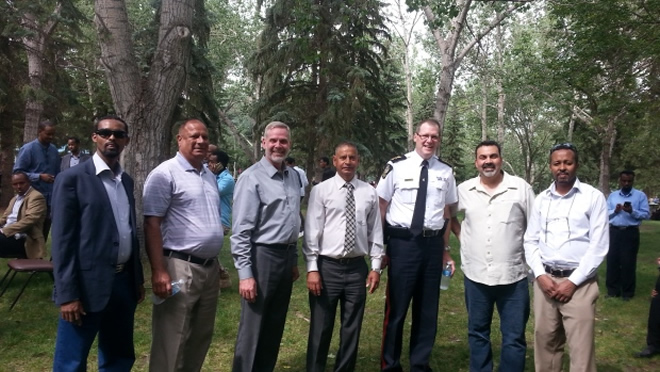
Members of the local Indigenous and Somali communities, pictured Saturday in Rundle Park, are working together to create greater cultural understanding and tackle issues like economic development and public safety downtown. (Supplied by Sheldon Hughes)
Racism, poverty, gang violence, and drugs — to tackle these issues, among others, the Indigenous and Somali communities are teaming up.
Their goal?
To make the downtown safer.
"The institutional backlash of colonial experience has created some complex and very stark realities," said Sheldon Hughes CEO of the Wicihitowin Society, a group which works to improve the lives of urban Indigenous people in Edmonton.
Although the trajectory for Somalis in Edmonton has been different, many aspects of those same unsettling realities resonate in that community as well.
The two groups first met up in April to discuss economic development. Both Hughes and Abdulkadir note how poverty has been an underlying problem contributing to lower levels of education, employment and run-ins with the justice system in their communities and other immigrant communities.
In May and June, the groups talked specifically about public safety — and will do so again in July.
By the end of the year, the plan is to have a list of recommendations for the city and the province on how to make the area safer. The recommendations will range from brighter streetlights to phones at bus stops and to more colourful storefronts.
Finding grassroots solutions
Hughes and Abdulkadir hope to engage other grassroots organizations and ongoing initiatives.
"Those types of stakeholders that are on the ground at that community level are able to provide that insight or that experience that oftentimes policymakers and other stakeholders are maybe not privy to," Hughes said.
Like the city and the police, the groups have been working to come up with solutions to challenges in downtown neighbourhoods.
The problem is that they've been doing so in isolation, Abdulkadir said.
"Duplication is the biggest problem where one community is doing something and another community is repeating the same thing the other community is doing," he said. "More than anything else, the difference is we're not aware of each other."
The nature of tribalism has historically accentuated differences that set groups apart.
"In order to engage fully with the broader community, one has to feel a sense of pride, one has to feel a sense of belonging and inclusion and understanding of what it means to be a particular culture, whatever it might be," Hughes said.
"By building those bridges between our cultures and being able to address some of those collective issues at play, it's going to give Edmonton the opportunity to provide a better quality of life, safer communities for our children, regardless of background."