
Wednesday December 30, 2015
By Betty Waitherero
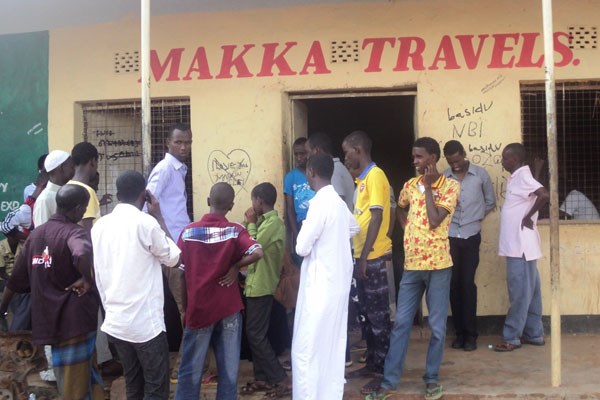
Relatives of those believed to have travelled in the bus that was attacked by Al-Shabaab militia outside the Makkah bus offices in Mandera. | MANASE OTSIALO | NATION MEDIA GROUP
December 2015 may be considered a turning point in public perceptions of Kenya’s mainly Muslim residents of Mandera. The bravery of locals during a bus attack last week by al Shabaab militants where Muslims shielded Christian passengers became an international story of resilience, hope and brotherhood in the face of violence.
For a brief moment, that particular tale of courage caused a flare of unity among Kenyans, the act of selflessness striking through the hard lines that many had established in the war against terror, where the extremist ideology of separation of Kenyans along religious lines had taken root in the national psyche. The actions of the gunmen in the April Garissa University College attack where they openly separated Christians and Muslims had become part of the xenophobic narrative, so much so that the Muslim victims of the attack were erased, as were any others in subsequent strikes in Northeastern.
Muslims in last week's bus attack, rightly deserved accolades for their bravery in shielding Christian victims. They took bullets, and put their own lives on the line for the sake of their Christian brothers. And yet, what has been forgotten by the nation, is that Muslims have been putting themselves on the frontline in the fight against violent extremists, willingly and also unwillingly ever since the rise of terror networks.
We praise the Mandera heroes yet we refuse to realise that they have been taking bullets, grenades, extra-judicial killings, executions, brutality, rape and countless attacks by both violent extremists and security agents for decades.
So the question now becomes, when is Kenya’s 80 per cent Christian population going to start putting themselves on the line for their Muslim brethren?
This is the psychology of terror – to divide an already deeply fragmented and highly ethnic national psyche even further, to rip apart any sort of unifying national ideology that is espoused by the constitution, to emphasize the flagrant abuse of constitutional rights by oppressive rogue state agents, and to show that our diversity is what keeps us apart, to the point of making our religious differences the sole reason one will live or die in attack.
The fact is that the Kenyan media has taken up the global Islamophobic narrative, and heaped that onto its already existing xenophobia against minorities such as ethnic Somali. Without questioning the consequences, the media will repeat, publish and broadcast videos created by al Shabaab, that are geared to emphasize religious and ethnic differences with the aim of spreading their twisted terror ideology.
The government, riddled with corruption in almost every sector, responds to the terror threats with collective punishment of Somali and Muslim people.
Intellectually, the results are plain to see. If we consider that a mere one per cent of Kenyans regularly use social media, we can safely judge that the national mindset is skewed against Muslims in general and Somali people in particular.
This sort of utter failure to assess the impact of broadcasting statements by terror groups in a nation that has as fragile a history as Kenya has especially in the north is the utter undoing of our press and the regime.
And yet despite this negativity and media and government driven xenophobia, and despite constant harassment and disenfranchisement through denial of identity, still the Muslims on the Mandera bus protected their Christian brothers during an attack by armed extremists. Why is that?
I propose that the answer lies deep within the very differences that terror groups wish to exploit. That though the same extremists tried to use Islam to separate the bus passengers, in that moment of extreme danger, the true fundamentalists of Islam stood up to the threat, pitting their own lives against the evil before them.
Violent extremists, religious or otherwise, try to exploit our differences to their own advantage, but the Mandera bus heroes showed us that ultimately our diversity is our strength. As a nation, we can no longer cower intellectually nor remain weak ideologically by dampening the light shown through our cultural, religious and ethnic differences.
It is time to amplify Muslim voices in Kenya, to support the true fundamentalists of a peaceful religious belief that has co-existed in harmony in East Africa for over a century. We must return the gift of sacrifice shown through decades in the battle against extremists in the Horn of Africa; we must rise up and embrace our diversity, find strength in our differences and protect Muslims in the war against terror, just as they have protected us. We must, and should demand that Kenyan Muslims be given the visibility they require, the protections of their rights by the state and most of all we must discard completely the global Islamophobic narrative that alienates millions of Muslim people worldwide, people whose lives are being sacrificed by our enemies.