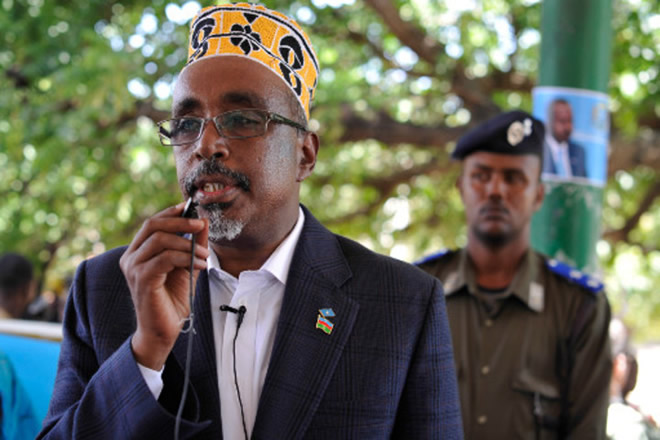
Interim South-western Administration President Sharif Hassan Sheikh Adan addresses a crowd during a December 20th meeting with local leaders and elders in Barawe. [UN Photo/ Ilyas Ahmed]

By Shukri Mohamed
Tuesday, December 30, 2014
advertisements
MOGADISHU — Somalia's newly formed Interim South-western Administration (ISWA) is seeking urgent solutions for prevailing insecurity and is working to bring communities which initially opposed its formation into the fold.On November 17th, delegates from Bay, Bakol and Lower Shabelle regions elected former transitional federal government parliament speaker Sharif Hassan Sheikh Adan to a four-year term as president of the new federal state.
But before Adan's election, which was welcomed by Somali federal government and international stakeholders, there had been protests in Baidoa, the new administration's seat.
Tensions centred on the claims of two rival camps which separately advocated the creation of a six region state and a three region state, with each claiming its own president.
After a series of talks mediated by the federal government, the six-region camp, led by Madobe Nunow Mohamed, agreed to accept the three-region state and enter into a power-sharing agreement.
According to the agreement, leaders from the six-region administration, which also included Gedo, Lower Jubba and Middle Jubba regions, will serve as vice president and speaker of parliament in the ISWA.
Gedo, Lower Jubba and Middle Jubba regions already comprised the Interim Jubba Administration, which has had its own hiccups forming under the federal government system.
Scholars and elders from the camp that supported the six-region administration need to be politically appeased, said Ibrahim Muse Herow, head of the Association of Bay and Bakol Scholars, a group of experts from various fields that works on issues related to reconciliation and governance.
"The creation of that administration was contested," Herow told Sabahi. "Some supported six regions and some wanted three regions, and there has not been a complete solution yet. However, it looks as though Sharif Hassan's camp has prevailed and has received the support of the government and the international community."
The new administration can succeed if it takes the right steps, he said.
"Sharif Hassan has to appoint a council of ministers that is balanced and satisfies all the clans since Somalis currently share power based on clans," Herow said.
"These regions also experience recurrent droughts and famine that cause the deaths of hundreds of people each year. The new administration has to come up with a plan to save the people who are dying," he said.
The ISWA is now finalising its governance structure, nominating its cabinet and directors of public offices, and will later move on to creating district administrations, said ISWA spokesperson Siad Sheikh Dahir.
"When the appointment of cabinet and district administrations are completed, we have to face the most important task, which is improving the lives of the people and their basic livelihood," he told Sabahi.
The administration will work to restore public infrastructure lost during the civil war, such as schools, roads and hospitals, he said. It also plans to restore security and liberate the towns still under al-Shabaab control.
Baidoa resident Abukar Sidow, 34, said he was happy when he heard that the two opposing sides had come to an agreement and are now focusing on rebuilding the three regions.
"Baidoa was in danger of descending into civil war, and there was a broad disagreement on the administration," he told Sabahi. "But now the situation seems calm, and all the people have their eyes on the new administration with high hopes of it changing the political situation and living conditions in these regions."
Sidow urged the federal government to redouble its support for the new state so federalism can succeed and Somalia can hold elections in 2016.