
By MURITHI MUTIGA
Sunday, June 12, 2011
 Fazul Abdullah Mohammed - Al-Qaeda's east Africa chief 'killed in Somalia' |
There were about five passengers on board and one of them would soon be one of the best loved members of that village of about 1,500 people.
Abdul Karim, as he said he was called, introduced himself as an Islamic preacher who had felt the urge to spread the word of God to the village.
A slight, quiet guy with a disarming manner, Karim was generous to a fault. He helped renovate the local mosque, taught passionately at the madrassa and married a local girl, 16-year-old Amina Kubwa.
All was revealed two years later, in November 2002, when a group of policemen and FBI agents swarmed into the village seeking to interview anybody that knew anything about Abdul Karim.
The villagers would later learn that the young man they had hosted was a seasoned Islamic militant and the reason they were receiving so many unwelcome guests was due to his role as the mastermind of the Paradise Hotel bombing which left 16 dead and dozens injured.
Fazul Abdullah Mohammed was born in the Comoros Islands in the early 1970s. Much about his early life is as fuzzy as his real age or even his correct name.
On the FBI website declaring him a most wanted fugitive, he is listed as using 18 different names and offering three different dates of birth on the multiple passports he held.
They also offered eight different photographs of the radical Islamist who they described as a master forger and expert in the art of disguise.
What the website does not say is that Fazul was arguably the most gifted and skilful al Qaeda operative the continent has known.
He was linked to all the major terror operations in the Horn of Africa in the last two decades, starting with the killing of 18 US servicemen in Mogadishu in 1993, the deadly US embassy attacks in Nairobi and Dar es Salaam and the Paradise Hotel bombing.
The cell he headed with Saleh Nabhan in Mogadishu was also blamed for plotting the Kampala World Cup final bombings last year.
Fazul’s journey to the Horn of Africa began in the lawless mountains of Afghanistan with a detour in Sudan and Somalia before he turned up in Nairobi.
According to a 3,000-word report on the 1998 embassy bombings compiled by American and Kenyan authorities, Fazul was one of a number of close associates of Osama bin Laden that trained in Kandahar and Peshawar in the late 1980s and early 1990s.
He was barely into his teens by the time he turned up in Pakistan to study medicine.
He soon abandoned his studies to join al Qaeda, leaving the training fields of Afghanistan a hardened fighter with a reputation for being good with computers.
Fazul arrived in Kenya in 1993 in the company of a Lebanese Christian who had converted to Islam and become a naturalised American citizen named Wadih El-Hage (El-Hage is now serving life imprisonment in America for his role in the embassy bombings).
Fazul and El-Hage set up an NGO called Help Africa People where they employed another associate, Muhammed Sadiq Odeh.
The plans to attack the US embassy gathered pace around May 1998. Fazul rented a house in the upmarket Runda estate.
House number 43, the FBI report notes, “was isolated by high walls that surrounded the property, making it nearly impossible for any passer-by to observe activity in and around the house. Moreover, the gated driveway was large enough to accommodate trucks, as was the garage. It is believed that the bomb used to destroy the US Embassy at Nairobi may have been constructed and actually stored at this location”.
|
|
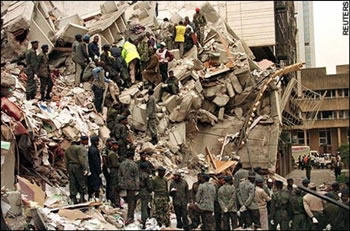
“Prior to the bombing,” the FBI report says, “two light coloured vehicles exited 43 Runda Estate. In the first, a pick-up truck, was Fazul, who led the second vehicle, a truck, containing the passenger Mohamed Rashed Al-Owhali and the driver Azzam to the US embassy.”
The embassy attack was the first large-scale assault on American installations by Osama bin Laden’s terror network. It killed 213 people, mainly Kenyans, and introduced the world to the new age of global terrorism.
Fazul played a big role in that attack. But it was not the last Kenyans would hear of the multilingual young man.
The way in which he plotted the 2002 Paradise Hotel attack showcased all the qualities for which al Qaeda’s senior operatives would become well known. He was patient and meticulous in his planning and was well financed.
His choice of Siyu Island as a base of his operations was a masterstroke. There can be few places in Kenya that are more isolated or more neglected by the government than that slice of land in the Indian Ocean 45 minutes by speed boat from Somalia.
By the time Fazul arrived in the village in 2000, there was barely any sign of the Kenyan government there.
The area had no piped water, infrastructure was at a bare minimum and the Kenya Power and Lighting Company was entirely unknown.
Even the Kenya Broadcasting Corporation signal did not quite reach the village.
When the Sunday Nation visited the village in 2004, a straw poll of seven children around the village well revealed none of them could name the President.
It was to this village that a strange man with grand designs for a terrorist attack found a hearty welcome among people that had no idea what his plans were.
“You must admire al Qaeda for their wisdom in choosing that area,” said Mohammed Ali Baddu, a local NGO programme coordinator two years after the attack.
“Not a single project has been undertaken for the past 40 years. How can any of these people turn away a good Muslim who comes with petro-dollars in the village to share with them?”
Among the projects he initiated was the establishment of two football teams for the local youth. He supplied them with kit and plenty of balls and the names he chose for them revealed he had a mischievous sense of humour.
One team, for which he played as a goalkeeper, was named al Qaeda while the other, according to the youth in the village, was called Kandahar after the Afghan area in which he had trained.
Fazul’s effort to win the hearts and minds of the locals was completed when he married into one of the village’s most prominent families, the Kubwa clan.
He preached regularly at the local mosque and taught in the village madrassa.
“Nobody could have suspected anything was amiss with the young man,” Ali Yusuf Ustadh, the preacher who presided over Fazul and Amina’s wedding at the Shanga na Uti mosque on the Island said.
“He was simply a very good preacher, very soft-spoken and mostly kept to himself.”
Beneath that quiet exterior was a fundamentalist hard at work on what would have been a spectacular terror attack if he had pulled it off successfully.
Together with his longtime collaborator Saleh Nabhan, Fazul coordinated the purchase of a green Mitsubishi Pajero KAA 8**N which was to be used by the suicide bombers to attack the tourist resort.
In a process similar to the one he undertook in the 1998 embassy attack, he rented a house in Mombasa’s Tudor estate surrounded by high walls where the bomb was to be fitted into the vehicle.
What is often overlooked is that Fazul also planned a simultaneous attack which would have surpassed the 1998 embassy bombings in the scale of the destruction it would have caused and the catastrophic publicity it would have earned Kenya as a tourist destination.
On November 28 2002, Fazul knew that an Israeli Arkia jetliner, Flight number 582, was scheduled to take off from the Mombasa International Airport with 264 Israeli tourists on board.
Most of those tourists would have been among those that had left the Israeli-owned Paradise Hotel earlier in the day.
The plan was for a suicide bomber, Fumo Mohammed Fumo, to attack the Israelis arriving at the hotel that morning while Fazul and Nabhan would bring down the Israeli plane using surface-to-air missiles.
According to Israeli media reports, the missiles were actually fired on target. What the militants did not know was that all Israeli passenger planes are fitted with technology that detects incoming missiles and helps to deflect them off the flight path.
Fazul’s bombers succeeded in killing 16 people at the Paradise Hotel. But if the plane attack had been completed effectively it would have represented the biggest mass murder of Jews since the Second World War.
That attack was the last major international terror plot in which Fazul was directly involved as a mastermind. Although he had been on the FBI’s list of most wanted fugitives since 2001, the focus on him became much more intense.
That drove him underground and his focus shifted from plotting mass murder to protecting his own life. He was variously alleged to have gone to the Comoros Islands and to Malagasy.
A few times he was declared dead only for the assertions to be disproved. He was also arrested at least once by Kenyan police in Mombasa although they later claimed he had escaped from custody.
The escalation of the hunt for al Qaeda leaders by the Obama administration meant that the rope was coiling ever tighter around Fazul’s neck.
Earlier this year, an African Union report prepared by the African Union Mission in Somalia (Amisom) reported that Fazul was leading a cell of jihadists operating out of Somalia.
This was part of a pattern where many al Qaeda fighters have been fleeing Afghanistan and Pakistan to Somalia due to an escalation in attacks by American drones in the region.
Apart from Fazul, others named in the report were Sheikh Mohamed Abu Faid (Saudi-born, financier and “manager” of al Shabaab), Abu Suleiman al-Banadiri (Somali of Yemeni descent and an adviser to the movement’s nominal leader, Ali Godane) and Abu Musa Mombasa (Pakistani, who arrived to replace Saleh Ali Nabhan, who was killed in a US military operation and is in charge of security and training) and Abu Mansur Al-Amriki (US-born, in charge of financing for foreign fighters).
The end of the road for Fazul came when he was stopped at a checkpoint by Somali forces on Wednesday.
There was confusion about whether or not Fazul was the man shot dead in the attack but a Kenyan counterterrorism official told the Sunday Nation, simply, that the militant was “100 per cent dead”.
He met as brutal a death as that he had inflicted on hundreds of others. It was ironic that Fazul’s death came so soon after the demise of his mentor, Osama bin Laden.
But because the young man’s involvement in terrorism on the local scene was so direct, his death in certain ways means more for local victims than bin Laden’s does.
“It may seem like a little thing to many,” said Ms Lucy Anyango Aringo, who was injured in the attack.
“But, to me, the death of Fazul gives peace to my soul. Although his death may be painful to someone close to him, to me it provides a closure of sorts.”