The Ahmed family's suburban story tells not only how Somali immigrants have changed Eden Prairie, but how Eden Prairie has changed the immigrants

By Jenna Ross, Star Tribune
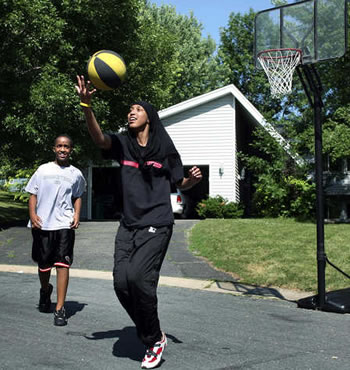
What age 15 means for Barlin's daughter, Khadro: Reading Barack Obama and playing basketball in the cul-de-sac of her family's Eden Prairie neighborhood.
Barlin shakes her head at the contrast. Then she gives a small, proud smile. "I have dedicated everything to giving them a better life."
Her five children tell her -- often and persuasively -- that she has succeeded.
 |
The Ahmeds are six people among a sizable Somali population that lives in Eden Prairie. While many Somalis moved to the United States in the 1990s, their subsequent migration to the suburbs came later, mostly since 2000. In Eden Prairie now, that number is estimated at between 2,500 and 3,500.
People talk about how immigrants are changing the suburbs, said the Ahmed family's friend, Martin Mohamed. But there's more to the story than that.
"Not only is Eden Prairie changing, but we are changing within it," he said.
Mohamed, who came to the United States nine years ago and Eden Prairie six years ago, points to the Ahmeds as a model Somali-American family.
They're hard-working, successful in school and politically engaged.
But they've paid a cost. "You have to understand how isolated this family is," Mohamed said.
Their assimilation can be seen through a simple lens: sports.
"We're a football family," said Koshin, the middle child. They indulge in junk food during the Super Bowl and dream of attending universities, such as Ohio State, known for their football teams.
All three Ahmed boys play football -- the eldest, Abdi, on Eden Prairie's ninth grade team. Their trophies, team photos and awards line the mantle. They are the only Somali players on each of their teams. It's the "wrong" sport for Somalis to play, Koshin said. They're supposed to play soccer.
But within the Somali community, the vast majority of which is Muslim, it's Khadro's playing that's most controversial. Since beginning basketball in fifth grade, she's had to respond to the same questions:
Don't you have to wear shorts to play? (Yes, she wears shorts.)
Do you keep your head covered? (No, she doesn't wear hijab while playing.)
Khadro constantly struggles with the questioning. "I love my culture. I love my religion," she said. When it comes to not wearing hijab, "Half of me says it's bad. But the basketball court is sort of separate from those things."
Khadro began playing basketball when the family lived in Hopkins, before moving to Eden Prairie almost three years ago. The Somali girls there would pick on her because of it, she said.
"It got pretty bad. It was a big part of why we moved here [to Eden Prairie]. So much drama."
Now, few of Khadro's friends are Somali, and they often comment that she's "not like the other Somalis" who hang in large groups in the school hallways.
Khadro's two worlds are reflected in her languages: "At school, I think in English. At home, I think in Somali."
Barlin struggles with some of the same pressures as her daughter. She's a strong, sometimes outspoken woman who will confront her children's teachers when necessary.
She draws on Islam often, especially when speaking to her children about the importance of education -- her favorite topic. Her children know her mantras well and repeat them without prodding.
"School is like a key to life," Koshin said one day last week as the family gathered for its daily reading hour.
"You can lose everything -- your car, your money, your house -- but you cannot lose your education," Khadro said.
While hundreds of Somali families live in affordable apartment complexes in Eden Prairie, Barlin instead rents a house in a quiet Eden Prairie neighborhood. There, without interference from other parents or other kids, she can mold the rules of her own household.
She works long hours at a Walgreens in Hopkins to pay for rent, gas and food. "If I am sick one day, I can't pay my bills," she said. With help from friends and sometimes coaches, she manages to cart the five kids to their practices, lessons and religious studies.
Occasionally, Barlin manages to get away to visit with friends and family in London, Holland and, recently, California.
She flipped through photos of her trip. In many, she poses in front of an aqua sea along a rocky beach. She's wearing colorful, stylish dresses, sunglasses and jewelry. And her hair is free from her hijab.
"It's not a good thing. I wear it always," she explained. "But sometimes... sometimes you can go outside your culture."
Jenna Ross • 612-673-7168 • [email protected]
Source: Star Tribune, July 03, 2007