Somali refugee held in his 4 kids' deaths
By Jessie Halladayand Peter Smith
The Courier-Journal
Saturday, October 07, 2006
 RELATED VIDEO: Tragedy at Iroquois Homes RELATED VIDEO: Press conference about Iroquois Homes homicide RELATED VIDEO: 4 children are dead and police say their father is under arrest - FOXNEWS RELATED VIDEO: Man Charged With Killing His Four Children - 32WLKY
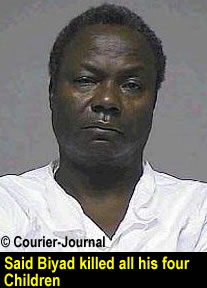 One by one, workers carried out the small, draped bodies of four Somali refugee children who police say were murdered by their father yesterday morning in their Iroquois Homes apartment.
Their deaths were apparently the result of an argument between their estranged parents that ended with 42-year-old Said Biyad striking his wife in the head and then killing his children, police said.
Police discovered the bodies of the four siblings, ranging in age from 2 to 8 years old, after Biyad walked into Louisville Metro Police headquarters downtown around 9 a.m. and calmly told detectives: "I just killed my family," said Lt. Col. Phillip Turner, an assistant police chief.
Officers also found the children's wounded mother, Fatuma Amir, who was taken to University Hospital. She was listed in serious condition yesterday.
Neither police nor the coroner would detail how the children were killed.
Biyad was being held without bond at Metro Corrections last night. He will be arraigned at 9 a.m. today, according to the jail records department.
According to the jail records, he is charged with four counts of murder-domestic violence; attempted murder-domestic violence; first degree rape-domestic violence; first degree assault-domestic violence; and tampering with physical evidence.
Police believe the incident, at 1427 Bicknell Ave., stemmed from an argument between Amir and Biyad over the children. Turner said the couple had been estranged, but it was unclear if Biyad had been living with the family.
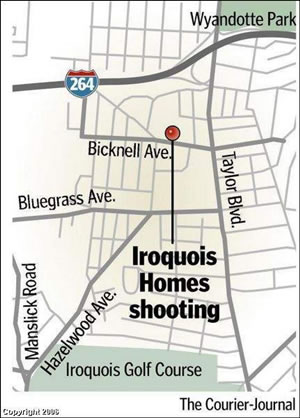 Police did not release the names of the 8-year-old boy and three girls -- ages 2, 4 and 7 -- who were killed, the youngest just short of her third birthday.
But Carol Young, director of Kentucky Refugee Ministries, which worked with Amir and the children, said the children's names were Sidi, the oldest, Fatuma, Khadija and Goshany, the youngest.
The three oldest children were Jefferson County Public Schools students, said spokeswoman Lauren Roberts, but she did not provide information about which schools they attended.
The family members were ethnic Bantus from Somalia who went to Portland, Ore., as refugees in 2004. Amir and the children moved to Louisville this spring, Young said.
Portland police records show that Biyad and Amir were involved in a domestic disturbance on March 24, 2005, that resulted in no charges filed, Officer Cathy Kent, a spokeswoman, said.
Concern for traditionsYesterday, dozens of people, including Somali refugees and residents, watched as police officers, evidence technicians and coroners pored over the scene.
For hours, women dressed in traditional Bantu clothing sat on the sidewalk just yards from the scene, rocking their children and talking in muted tones. Men stood nearby, periodically meeting as some translated between police and the Somalis who were there.
"This is something that never happens," said Hassan Muya, president of the Bantu Community Association. "We never see somebody kill his family."
One of the concerns was burial for the children. Muslim tradition calls for the dead to be buried within 24 hours. But the autopsies, which were to be performed this morning, made it unclear whether that would be possible.
"The way they want to do is not what we want to do," Muya said. "It's difficult."
Omar Ayyash, director of the metro international affairs office, said he was trying to coordinate with the law enforcement officials to help speed the process to meet the religious needs of the family.
"We are very sensitive to the culture," Ayyash said.
Among those hoping for answers yesterday was Amir's brother, Osman Noor.
Noor said he got a call yesterday morning from his aunt, whom Amir had called and told about the attack. Noor, who lives in the Park Hill public housing complex, went quickly to the scene.
By the time he arrived, his sister had already been taken to the hospital and he was told by police that the children were dead.
"They was wonderful children," Noor said. "I'll miss them."
Noor said Biyad was a "nice man, but I don't know what happened."
Mother had found jobYoung said Amir and her children moved to Louisville without her husband. The agency did not know when he arrived in Louisville.
Young said Amir never gave any indication that there was a threat of domestic violence.
The ministry had just helped Amir arrange for child care and a job at an assembly plant, Young said.
"From what I understand, she was happy and doing well in her job," Young said, adding that she was an eager participant in the ministry's English classes.
"Everybody's just reeling," at the ministry, she said.
Hundreds of Bantu refugees live in Louisville; many have been helped by Kentucky Refugee Ministries and Catholic Charities.
Young said the Bantus have made great strides in their short time here in Louisville and that they are shocked by the murder.
"The Bantu community is a very gentle community," she said, with members who are "extremely supportive of each other."
Mourners gatherAs news spread of the killings, more Somali refugees converged on the scene. Volunteers came to help translate for police.
By evening, On Fire Christian Center had set up a prayer vigil outside the scene to allow residents a chance to mourn.
Early on, Mayor Jerry Abramson came to the scene to help coordinate city services to help the family.
He described the killings as "just an incredible tragedy. As a parent, it's beyond unthinkable."
The Rev. Sandra White, with No Murders Metro -- a group that formed in response to killings in the Louisville area -- came to the scene to offer her support and comfort to the family and residents.
"It's all senseless," she said. "You can't understand."
Conedia Compton spent much of the day watching the scene unfold from her porch across Bicknell Avenue.
"It hurts me more because babies were involved," Compton said. "You open your doors and you never know what you're going to walk into."
Reporter Jessie Halladay can be reached at (502) 582-4081.
Reporter Peter Smith can be reached at (502) 582-4469.
Reporter Charlie White contributed to this story.
Source: The Courier-Journal, Oct. 7, 2007