|
Encamped Mooryaans at the Hiilweyne camp. |
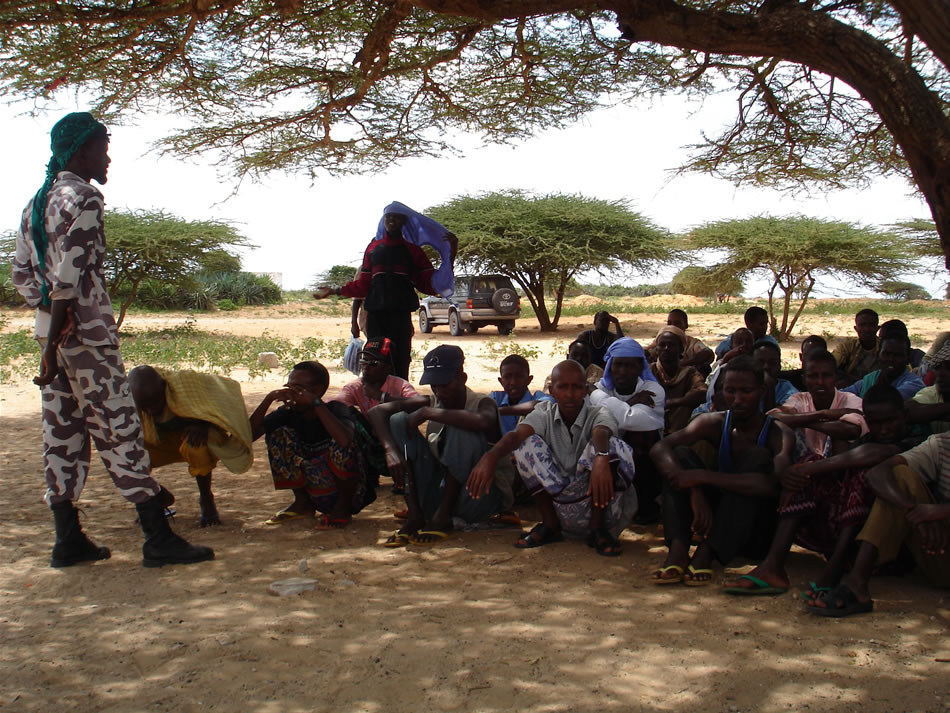
MOGADISHU, 17 Oct 2006 (IRIN) - At Hiilweyne military training camp, north of the capital, Mogadishu, Ali Mohamed Abdi recants his sins. Until a few months ago, he was one of Somalia’s notorious young gunmen, looting, raping and killing, living on 'khat' – a narcotic leaf - cigarettes and amphetamines. Now he finds direction and discipline in the Koran.
"When I was a warlord militia I thought I was right, I thought I was a hero. I was proud. But now I realise how wrong I was, committing crimes against the people, looting, torturing people, hijacking cars and killing. When I think of the things I was doing I feel traumatised, because it was very, very bad … now I know the right path to follow, thank God."
On a Thursday afternoon, 28-year-old Ali, from Baidoa, is one of a handful of recruits relaxing under the mango tree outside the administration block; most have gone home to their families in Mogadishu for the weekend.
Many wear red Saudi-style head scarves, with or without uniform. Other former 'mooryaan' – young gunmen who fought for their clan - recant along the same vein as Ali, all concluding, "I am here to defend my religion and my country."
Learning discipline
Colonel Muhyadin Haji Ali, a former officer at the camp, is commander of Hiilweyne. He had been cultivating his farm near Mogadishu since the collapse of the government. "Officers like me were called by the UIC when they took power, because we are experts here … we accepted to train the militias and the UIC facilitate and pay us."
He explains that at first the young ‘mooryaans’ had to learn personal and religious discipline so they could be reintegrated into the community they had terrorised for so long. The self-discipline and self-criticism are rooted in a revolutionary Islamic ideology. "Every morning they get up and pray and do other religious activities. They are sheikhs now, not mooryaans."
The young militiamen were encamped when their paymasters, the warlords, were defeated in June. Captured battlewagons, or ‘technicals’ – the spoils of war – are lined up under iron-sheet roofs near the camp kitchen. Huge military trucks with multiple anti-aircraft missiles stand silent but serve eloquently as a reminder of the fire-power behind the gunmen who used to rule the streets of Mogadishu. Now the reformed youth are being trained to be part of a unified force for the Islamic Courts.
Unlike previous efforts at encampment and disarmament in the past 16 years, this ‘boot camp’ appears to be having some success. While the discipline may have been alien to the young militia, the Islamic ideology is not. Along with the principles of being a devoted Moslem, they are taught about ‘jihad’ – the holy war – and are prepared to defend their country and their religion from enemies outside and inside the borders.
"It gives them a goal, a meaning to their lives. They really can be heroes," said one observer.
Hiilweyne is one of four camps established by the UIC to train their forces.
Walking around the camp, Colonel Muhyadin volunteers a denial that any "foreigners" are being trained in the camps. "When the US wants to attack somewhere they say terrorists are there. There are no terrorists here. And there are no foreigners here." He dismisses speculation circulating in Mogadishu and the western press that the UIC has used foreign military advisers or is using the camps to train foreigners. "Journalists are free to come and see with their own eyes."
In the past two weeks, the UIC has centralised the administration and the forces of the 27 branches of the UIC in Mogadishu. Some of the courts hold seminars, including for women, where they are taught household management and first aid to support the fighters.
Sheikh Sharif Sheikh Ahmed, chairman of the UIC, says security is still the top priority. With Mogadishu residents enjoying unprecedented freedom of movement, Sharif says there is still a security concern over "those who are responsible for the collapse of the country, including the warlords who are still established in Somalia - that’s our main challenge".
On 9 October, Sheikh Sharif called a press conference and appeared in military uniform to announce a jihad against neighbouring Ethiopia, accusing its government of interfering in Somali affairs and sending its troops across the border to support the Transitional Federal Government.
He says the declaration of jihad "was not concerning the international community but Somali citizens, and all Somali citizens are ready to defend their country with jihad if the Ethiopians don’t stop their intervention".
The Ethiopian government has denied the accusation.
Many Mogadishu residents have taken up the call, and see "US-backed Ethiopia" as the main threat to the UIC. Others are uneasy about the militarisation and revolutionary ideology of the UIC and wonder how long their new-found freedoms will last.
For Ali Mohamed Abdi, there are no doubts about the way forward. "For my future, the most important issue is security. If we get security, God willing, then we will develop our lives and earn a living. If we don’t get security, we won’t have a future."
He says he will think about civilian life when he has done his duty for his religion and country. "I was a Moslem then and I am a Moslem now, but now I am practising the religion. At that time I think evil was leading me. I came here to defend the country and protect my religion first."
lh/ah/mw
[ENDS]
Source: IRIN, Oct. 17, 2006