Tuesday, October 17, 2006
By Marie-Louise Gumuchian
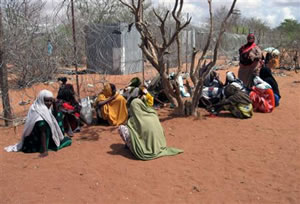 HAGADERA REFUGEE CAMP, Kenya (Reuters) - Quoting a Somali proverb, Dahir Mohamed Ali describes how long-time refugees living in Kenya fear they will be forgotten as a growing tide of Somalis fleeing conflict pour across the border.
"When there is fresh water, do not forget the rivers that are drying up," said the former leader of Hagadera refugee camp, in northeastern Kenya.
Thousands of Somalis have crossed into Kenya in the past weeks as powerful Islamists extend their grip over south-central Somalia, effectively flanking an interim government confined to the provincial town of Baidoa.
Some 35,000 Somalis have sought refuge in Kenya this year.
"They are putting pressure on food, water and even security," said Ali, an ethnic Somali from Ethiopia's Ogaden region who arrived in the camp in 1991.
"They need water and there are no more boreholes. People are starting to beg us for what we have, they beg for a place to stay," the father of five said.
About 162,000 people live in the three vast, dusty Dadaab camps, lying some 100 kms (62 miles) from the Somali border in flat, barren land strewn with thorn bushes.
The camps were established in 1991 after warlords ousted Somalia's military dictator Mohamed Siad Barre and the country descended into anarchy.
Somalis account for some 98 percent of those living in the camps, and the rest are a mixture of Ethiopians, Sudanese, Congolese and Rwandans.
Living conditions are precarious with new arrivals throwing sheets, rags and bags over thin branches, bent and tied to form dome-shaped shacks.
Some old timers, like Ali, have relatively well-established dwellings made from U.N.-donated building materials, supplemented by corrugated iron, wood and mud.
They protect themselves from the threat of bandits with thorn bush fences.
"WE ARE DIFFERENT"
Required to stay in the camps rather than go out to look for work or cultivate land, most of the refugees rely entirely on handouts of wheat flour, pulses, beans, maize meal and vegetable oil from the U.N. World Food Program (WFP).
Malnutrition rates stand at 22 percent, above a 15 percent emergency threshold.
WFP warned last month it might have to cut rations as the growing tide threatened to exhaust stocks. It has now received donations to secure distributions until March.
"This has put us on the safe side, but it doesn't mean we are out of the trap," said Josephine Muli, WFP Program officer.
"No one can predict what will happen in Somalia. If it goes beyond 1,000 (refugees a day), we might have to go back to the drawing board."
Some fear tensions may arise over supplies or as new refugees, unacquainted with camp culture, impose their ways on the thousands well established in their tent cities.
"We're fearful that there will be tensions with the old caseload," said Geoff Wordley, a senior UNHCR emergency officer and officer in charge of the Dadaab camps.
"The old caseload has been squeezed in terms of the assistance they've been given. They only get a plastic sheet every year ... but these new people who are coming in are given a plastic sheet straight away," he said.
Some non-Somalis are also frightened the new arrivals could import political and ethnic tensions.
Outside the camps, Somalia's Islamists and Ethiopia are sparring verbally. The Islamists have declared holy war against Ethiopia, which they say has sent troops into Somalia to prop up the government. Addis Ababa says Somalia's Islamists are led by terrorists.
"I fear they will take out the stand-off on us," one Ethiopian refugee said of the newcomers. "I'm scared."
Ali says the new arrivals are unlike the old timers who have adapted to refugee life. "We know what refugee life is like. They have a new behavior, a new character," he said. "We are different."
Source: Reuters, Oct. 17, 2006